



ERA Group’s quarterly insights regarding market conditions, potential impacts on procurement, and supply chain planning.
General supply chain observations & updates
Please note, as we all know by now, the tariff situation is extremely fluid. By the time you read this newsletter, chances are things have changed yet again. Most notably, on April 10, 2025, President Trump announced a 90-day pause on the ‘reciprocal’ tariffs, with the exception of China.
The reintroduction and expansion of U.S. tariffs in early 2025, ranging from raw materials like steel and aluminum to finished goods such as screws, fasteners, and automotive parts, has jolted the manufacturing sector. These policies are no longer abstract trade headlines; they are now actively reshaping sourcing strategies, distribution networks, warehouse operations, and cost structures across the supply chain.
In response, many manufacturers and distributors rushed to frontload inventory ahead of the tariffs, driving a 14% year-over-year increase in inbound container volumes at major U.S. ports.1 The result: a familiar crunch in warehouse space and a spike in storage rates, reminiscent of the early COVID-19 era.
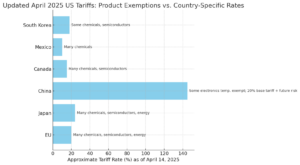
Chart Data: Chemical & Engineering News (Apr. 2025); USTR announcements
Tariffs are also forcing companies to revisit their long-term sourcing and supply chain strategies. While some industry voices have advised simply absorbing the cost and waiting for policy to shift, others see this as an inflection point - a chance to build resilience.2 Many firms are now exploring nearshoring, multi-node distribution models, and supplier diversification in tariff-exempt regions.3
However, it’s not just about sourcing. Technology and visibility are emerging as mission-critical tools. Companies that invest in real-time analytics, such as ERA Group’s SpendVue ™, will be better positioned to navigate rising costs, avoid chargebacks, and maintain service levels amid disruption.4
Importantly, while many products - including most chemicals, pharmaceuticals, semiconductors, and energy-related goods - have been exempted from the new U.S. tariffs, exemptions do not automatically mean tariff-free treatment. Several countries, including China, are still subject to elevated duties or port fees, even on products that are on the exemption list. For example, China faces both heightened country-specific tariffs and multimillion-dollar shipping surcharges for vessels flagged or built there, effectively raising costs on goods that might otherwise be considered exempt.5
Although the vast amount of information, and misinformation, surrounding tariffs may seem overwhelming, keep in mind that not everything will be affected. It is more important than ever to investigate proposed price increases and maintain open communication with your suppliers. Understanding the origin of goods, not just their category, will be key to controlling costs in the quarters ahead.
KEY TAKEAWAYS: With tariff rules shifting rapidly, and exemptions varying not just by product but also by country of origin, it’s critical to look beyond headlines. Now more than ever, manufacturers should partner with sourcing and supply chain experts to validate price increases, assess true landed costs, and determine whether supplier price hikes are genuinely tariff-related or an opportunity to pad margins.
Corrugated
Corrugated box prices have remained relatively stable in the U.S., Asia, and Europe through Q1 2025 despite newly implemented U.S. tariffs on imported kraft and recycled paper. That stability was largely due to balanced supply and demand, with U.S. manufacturers successfully offsetting rising input costs through optimized production and localized sourcing. That said, the market increase announced by RISI PPW in late February is being implemented now, and we are bracing for the possibility of additional increases in the coming months. Lastly, industry analysts expect prices to increase further in the coming months as tariff impacts ripple through supply chains. 6,7

Chart Data: Pulp and Paper Weekly RISI Index
KEY TAKEAWAYS: Announced increases for April and broader inflationary pressure suggest a likely upward trend for corrugated pricing. If your suppliers have not yet implemented increases, we recommend locking in pricing now or confirming timing before rates climb. For clients without index-based pricing protections, we strongly advise negotiating formal agreements tied to market benchmarks to avoid opportunistic hikes. Early action will be critical to controlling packaging costs in Q2 and beyond.
Lumber/pallets
A slowdown in construction, coupled with a stronger Canadian dollar and falling Canadian exports, has softened U.S. demand for Canadian lumber and contributed to a pullback in prices.8 At the same time, some regions like the Northeast are seeing rising demand for species such as Red Oak and Poplar, with buyers advancing purchases ahead of potential tariff-related price hikes. Mills continue to operate below capacity due to labor shortages, but raw timber costs remain the primary margin concern.9

Chart Data: Pallet Market Stability after Tariff Drama, fastmarkets.com
Pallet prices, meanwhile, have remained relatively stable through Q1 despite early-March volatility.10 Modest price increases are expected as the year progresses, driven by localized lumber cost pressures and lingering supply chain risks. Regions with access to diversified lumber sources have fared better, but pallet buyers should prepare for potential second-half price adjustments.11

Chart Data: TradingEconomics.com
KEY TAKEAWAYS: Lumber buyers should take advantage of current price softness, particularly for Canadian imports, while keeping an eye on regional species that may see upward movement due to localized demand. Pallet pricing has remained stable, but modest increases are expected later this year as lumber costs and supply constraints ripple through the system. We recommend locking in pricing and volume commitments now - especially in regions without diversified lumber access - to minimize exposure to potential Q3 and Q4 cost hikes.
Chemicals & gasses
In a major policy shift, the U.S. has announced sweeping new tariffs on imports, but most bulk chemicals will be spared. Key exemptions include polyethylene, polypropylene, ethylene, and titanium dioxide, critical inputs across manufacturing sectors. While this shields many chemical buyers from immediate cost increases, industry groups remain wary of broader supply chain impacts, including proposed maritime fees. Analysts expect downstream demand to take a hit, particularly in chemicals tied to durable goods and apparel.12
While pharmaceuticals were exempt from the highest retaliatory tariffs, the life sciences sector - heavily reliant on global raw material sourcing - faces rising costs and supply chain uncertainty. Trade groups warn that these broad tariffs could act like an excise tax, threatening innovation and margins across the healthcare system. Some larger manufacturers may fare better due to stronger domestic footprints, while firms importing from Europe face greater exposure.13
KEY TAKEAWAYS: Take advantage of the current exemption for core bulk chemicals like polyethylene and ethylene by locking in pricing where possible before any further trade adjustments occur. For pharmaceutical buyers, now is the time to review sourcing strategies - especially for European imports - and explore U.S.-based or tariff-exempt suppliers to avoid margin pressure. Across sectors, staying proactive on shipping logistics and re-evaluating supplier diversity will be critical as maritime fees and retaliatory tariffs evolve.
Plastics
The April 2, 2025, tariff announcement from the Trump administration is set to disrupt global plastics trade, with a minimum 10% tariff on all imports and up to 49% on certain goods from key trading partners. While polymers like polyethylene (PE) and polypropylene (PP) from Canada and Mexico appear exempt under USMCA, global trade flows, especially from the EU and Asia, face higher costs and uncertainty.
These tariffs could boost demand for U.S.-produced resins as imports become less competitive, though retaliatory measures and shifting sourcing strategies may reshape supply chains. Industry groups warn of rising production costs and reduced competitiveness for plastics processors, especially those reliant on imported feedstocks.14

KEY TAKEAWAY: The latest round of U.S. tariffs is poised to increase costs and disrupt sourcing for plastics manufacturers, particularly those reliant on imports from Europe and Asia. With Canadian and Mexican PE and PP largely spared under USMCA, now is the time to prioritize North American resin suppliers and reevaluate international procurement strategies. Clients should prepare for potential price volatility and consider negotiating domestic supply contracts to protect margins as global trade dynamics shift.
Metals
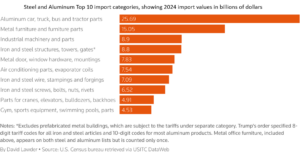
The Trump administration’s expanded 25% tariffs on imported steel and aluminum - now covering nearly 300 product categories - are already impacting pricing and procurement across the manufacturing sector. Unlike prior rounds, these new tariffs include downstream goods such as fasteners, construction fittings, automotive components, and even items like horseshoes and bulldozer blades.15 As a result, metal buyers are seeing elevated costs not only on foreign materials but increasingly on domestic steel as well, as U.S. producers raise prices in response to tightening supply.16
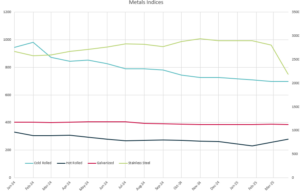
Chart Data: BusinessAnalytiq
Manufacturers are reporting immediate cost pressures, especially those dependent on imported screws, bolts, and specialty steel components, where domestic alternatives are limited or unavailable.17 Many buyers are now accelerating efforts to find local suppliers or reshoring production, though capacity constraints continue to present challenges. Meanwhile, flat-rolled steel pricing is showing early signs of stabilizing as lead times shorten and inventories improve slightly, but ongoing trade policy uncertainty may continue to drive price volatility in Q2.
KEY TAKEAWAY: We advise you to closely monitor changes in tariff scope and avoid short-term buying delays, particularly for fabricated steel and aluminum goods with limited domestic sources. Where possible, consider securing pricing agreements or forward buys to hedge against mid-year increases, as the full impact of these policies plays out.
About the authors

Travis Cantrell and Patrick Garr are Manufacturing Specialists at ERA Group. They both hold engineering degrees and have over 29 years of collective experience studying complicated client expenditures in direct material, industrial chemicals/gases, packaging supplies, and factory consumables/MRO. ERA utilizes its in-depth subject-matter expertise to negotiate with suppliers and deliver best-in-class sourcing solutions for their clients.
_______
Sources:
1- Talking Supply Chain Podcast with Tracy Ortiz, SPS Commerce (March 2025); 2 – Wall Street Journal, “Tariffs on Screws Are Already Hitting Manufacturers” (March 30, 2025); 3 – Manufacturing Dive, “A ‘Wobbly’ Moment in Business: Manufacturers Face Life Under Trump’s Tariffs” (April 4, 2025); 4 – Talking Supply Chain Podcast with Tracy Ortiz, SPS Commerce (March 2025); 5 – “New US Tariffs Spare Many Chemicals,” Chemical & Engineering News; 6 – Corrugated Box Prices Hold Steady Despite U.S. Tariff Increases, U.S. Likely to Face a Hike, chemanalyst.com; 7 – Greif to increase prices on uncoated recycled paperboard and other grades, thepackagingportal.com; 8 – TradingEconomics.com; 9 – Northeast Business Trends–April 2025, millerwoodtradepub.com; 10 – Fastmarkets – Pallet Market Finds Stability After Early Month Tariff Drama; 11 – Fastmarkets – Three Key Predictions for the US Pallet Market 2025; 12 – “New US Tariffs Spare Many Chemicals,” Chemical & Engineering News; 13 – “Drug and Device Makers Confront Trump Tariffs,” Axios.com; 14 – US Tariffs Set to Reshape Global Polymer Markets, theplasticsexchange.com; 15 – Trump’s expanded metals tariffs to hit goods from horseshoes to bulldozer blades, Reuters.com; 16 – Are Steel Prices Coming Down? Ryerson.com; 17 – “Tariffs on Screws Are Already Hitting Manufacturers,” Wall Street Journal (March 30, 2025)













.jpg)
.jpg)
.jpg)
.jpg)
.jpg)