All posts
H1-2026 Benefits Bulletin: Navigating Rising Costs, Legislative Shifts & the Evolving Workforce Benefits Landscape


The first half of 2026 marks a pivotal inflection point in employer-sponsored benefits. Healthcare costs are surging at their highest rate in 15 years, driven by specialty pharmaceuticals, GLP-1 medications, and provider consolidation. This dramatic cost increase is forcing some employers to make difficult decisions. Simultaneously, landmark PBM transparency legislation has been signed into federal law, reshaping the pharmacy benefits landscape. Employers face the dual challenge of controlling costs while meeting evolving workforce expectations around mental health, financial wellness, and personalized benefits.
This bulletin synthesises insights from 16+ industry sources to provide actionable intelligence for benefits decision-makers.

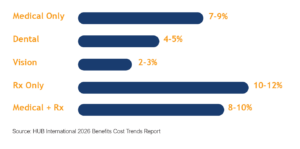
The Society of Human Resources Management (SHRM) also projects health care costs to rise by 10%, driven by catastrophic claims and GLP-1 medications. Regional variations: East and Pacific regions are experiencing trends 1–2% above national averages.
Naturally, self-funding offers a lot of flexibility in being able to incorporate various cost control elements, such as Direct Primary Care and Onsite clinics, Direct Contracting, Bundled Procedure
Pricing, Point Solutions, Pharmacy carve-outs, including specialty sourcing, Reference-Based Pricing, etc.
Self-funding and the ability to enhance control over plan costs were historically available only to larger employers. However, these solutions have become accessible to smaller employers – even
if traditional self-funding may be too large a step to take. Captives and other bundled “off-the-shelf” solutions provide the ability to incorporate self-funding and supporting cost containment strategies.
Lastly, ICHRAs (Individual Contribution Health Reimbursement Arrangement) are gaining popularity. Introduced broadly in 2020, for all intent and purposes, ICHRAs convert an employer’s health plan to a defined contribution plan – employers provide a subsidy which the employee uses to secure coverage on the individual market. Employer adoption of ICHRAs increased by 34% from 2024 to 2025 for employers with 50+ employees (up from 29% adoption between 2023 to 24). While an ICHRA is a significant change, it has generally been received positively by employees, with strong reported satisfaction. In order for ICHRAs to be a viable option in a particular locale, the individual market must be reasonably priced and offer plan/carrier variety.
GLP-1s have rapidly become one of the most consequential impacts in employer-sponsored plans. Originally approved for diabetes management, expanded use for weight management has created a surge in utilisation that is fundamentally reshaping pharmacy cost structures and employer coverage decisions.

GLP-1s have created two distinct markets: diabetes care with clear clinical justification, and weight management are the areas where coverage varies widely among employers.
Nearly a third of employees say GLP-1 coverage could influence their employment decisions, making this more than a cost control issue - it’s a talent strategy consideration.
EMPLOYER GLP-1 STRATEGIES FOR 2026
In certain areas of the country, some carriers are proactively eliminating GLP-1 coverage for weight loss and only extending the coverage for diabetic treatment. While this is an aggressive stance on the carriers’ part, it may become more prevalent over time.
49% of self-funded employers now carve out pharmacy benefits with a PBM, up from 27% in 2025, reflecting growing sophistication in pharmacy cost management.
In a landmark bipartisan action, the Consolidated Appropriations Act of 2026 (HR 7148) was passed by the House 341–88, approved by the Senate 71–29, and signed into law on February 3, 2026. This legislation represents the most significant federal reform of pharmacy benefit management in decades.
Key Provisions
The Great Healthcare Plan
In January 2026, the administration announced ‘The Great Healthcare Plan,’ which includes a mandate to end kickbacks from PBMs to large brokerages acting as middlemen. The White House asserts these payments ‘deceptively raise the cost of health insurance.’ The plan is targeting taxpayer savings of at least $36 billion and a reduction of 10% to common ACA plans.
No Surprises Act Update
WATCH: EMERGING PBM DEVELOPMENTS
MetLife’s 24th annual study reveals that workforce wellbeing has stalled, with cost pressures outpacing investments. For the first time since 2022, controlling health costs has surpassed talent retention as employers’ top benefits objective.

“Job Hugging”: The Hidden Retention Risk
While 77% of employees intend to stay, 56% stay out of necessity, not commitment. Financial confidence has fallen to its lowest level since 2012. 31% say the uncertain job market makes leaving too risky.
MENTAL HEALTH AS STRATEGIC PRIORITY
Gen Z now comprises 18% of the labour force and disproportionately reports mental health challenges, requiring employers to rethink support models.
Mental health leaves surging while employer investment per employee dropped ~7% year-over-year.
The Approach to Mental Health
Fiancial Wellness & Retirement
Financial stress is a top driver of reduced engagement and productivity across all demographics. Additionally, not all employees have the same needs – organizations need to understand the financial diversity of their workforce. According to the Business Group on Health, in 2025, 92% of employers included financial health as a dimension of their wellness strategy, with 100% of employers projected to include it for 2026.
Employers are seeking comprehensive solutions to simplify complexity – a one-stop shop that incorporate solutions to address immediate financial needs, such as earned wage access, with budgeting and savings tools that help employees build for the future. Similar to the trends seen in mental health, incorporating a skillsbased approach to financial wellness helps set up employees for success in the future. As the old adage goes – teach a man to fish, feed him for a lifetime.
The most popular financial wellness benefits for employers to offer are:
Emergency Savings benefits – including employer-sponsored emergency savings accounts (ESAs), payroll deducted savings programs and Secure 2.0 sidecar emergency accounts. These help to reduce 401(k) loans and financial stress as most Americans cannot cover unexpected expenses without debt.
Student Loan Support and Debt Management – including repayment benefits, Secure 2.0 student loan matching contributions (including integration with retirement matching), along with Debt counseling and repayment planning tools. Student debt has become of the biggest barriers to saving.
Earned Wage Access and Flexible Pay – which provide employee access to wages before payday. This appeals to workers living paycheck-to-payheck and can circumvent a need for high-interest loans.
Personalized Financial Coaching and Digital Tools – including AI-driven tools, retirement calculators, and debt and savings planning tools.
There has been a strategic shift from education towards financial outcomes. Seminars and financial literacy training have been replaced with actual financial benefits, automated savings, debt support and integrated retirement programs. Increasingly, employers are looking to help employees manage short-, mid-, and long-term financial risks.
According to a survey conducted by the National Financial Educators Council, 51.6% of employees say they would be more productive at work if their personal financial situation were more secure.
Artificial intelligence is transforming benefits management faster than anticipated. From personalized benefit recommendations to automated enrolment and claims processing, AI is reshaping both the employee experience and HR operations. However, a critical governance gap has emerged.
AI Adoption Snapshot
Benefits Personalization
Cigna projects U.S. companies could lose between $1.3 trillion and $5.1 trillion in 2026 if turnover trends continue and 34% of the workforce changes jobs. Benefits are no longer a support function—they are a strategic lever for attracting and retaining top talent.
About the Authors
Stephanie Scarola and Paula Kaeser are insurance specialists with ERA Group. They come from opposite sides of the industry and have over 35 years of collective experience in insurance. They assist clients in evaluating their insurance and benefit programs. ERA utilises its in-depth subject-matter expertise to evaluate arrangements, negotiate, and deliver best-in-class sourcing solutions for its clients.















.jpg)
.jpg)
.jpg)
.jpg)
.jpg)