

The North American uniform and workwear industry is undergoing its most dramatic transformation in decades. Two landmark events—Aramark’s spin-off of its uniform division as Vestis Corporation and Cintas’s announced $5.5 billion acquisition of UniFirst—are fundamentally reshaping the competitive landscape.
For businesses that rely on managed uniform and workwear services, these changes present both risks and opportunities that demand attention.
A Brief History of an Industry in Motion

The managed uniform and workwear industry has its roots in small, family-owned laundry operations dating back to the late 1800s. Over more than a century, consolidation and innovation have transformed these regional businesses into a national industry now estimated at $48 billion in the United States alone.
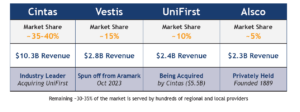
Cintas Corporation, founded in 1929 by the Farmer family in Cincinnati, Ohio, grew from a small document shredding business into the industry’s undisputed leader, reaching $10.34 billion in annual revenue by fiscal year 2025. UniFirst Corporation, founded in 1936 by Aldo Croatti in Boston as the “National Overall Dry Cleaning Company,” built a respected national presence with approximately $2.4 billion in annual revenue.
Aramark entered the uniform space through acquisitions, building its Aramark Uniform Services (AUS) division into a significant competitor before spinning it off as Vestis Corporation in October 2023. Alsco Uniforms, the oldest player in the industry (founded 1889 in Lincoln, Nebraska), remains a privately held global competitor with approximately $2.3 billion in revenue and operations across ten countries.
Today, the top four national providers collectively hold roughly 28% of the total U.S. uniform services market, with the balance served by hundreds of smaller regional and local providers. The chart below illustrates the current competitive landscape:
The Aramark–Vestis Spin-Off: A New Independent Player
In October 2023, Aramark completed the spin-off of its uniform and workplace supplies division, creating Vestis Corporation (NYSE: VSTS) as an independent publicly traded company. Its service offering includes uniform rental, cleanroom garment processing, floor mats, towels, linens, managed restroom services, and first aid supplies.
However, Vestis’s early journey as a standalone company has been challenging. Revenue has declined year-over-year, with lost business outpacing new customer acquisition. The company reported a business retention rate of approximately 91.9% in recent quarters and has faced margin pressure, leading to a comprehensive business transformation plan focused on commercial excellence, operational excellence, and asset optimisation. A new CEO, Jim Barber (formerly of UPS), was appointed in mid-2025 to lead the turnaround effort.
What this means for customers: Vestis is actively working to retain and attract customers, which can create favourable negotiating conditions. A company in transformation mode is often more willing to be flexible on pricing and service commitments. At the same time, customers should monitor service quality closely, as operational disruptions during a transition period are not uncommon.
The Cintas–UniFirst Merger: Industry Consolidation at Scale

On March 11, 2026, Cintas and UniFirst announced a definitive agreement for Cintas to acquire UniFirst for $310.00 per share in cash and stock, representing an enterprise value of approximately $5.5 billion. The deal, which follows an initial unsolicited proposal of $275 per share in December 2025, is expected to close in the second half of 2026, subject to shareholder and regulatory approvals.
The combined entity would serve approximately 1.5 million business customers across North America and is expected to generate roughly $375 million in operating cost synergies within four years by integrating route networks, processing facilities, supply chains, and technology platforms.
What this means for customers: This merger will create a dominant market leader with unprecedented scale. While Cintas promises expanded service capabilities, the consolidation reduces the number of national-scale competitors. Customers currently served by UniFirst should prepare for potential changes in service teams, pricing structures, and contract terms during integration. For all uniform buyers, reduced competition at the national level may limit leverage during negotiations if proactive steps are not taken.
What These Changes Mean for Pricing and Options
The convergence of these two events creates a pivotal moment for businesses that purchase uniform
and workwear services. Here are the key dynamics to understand:
- Reduced National Competition
If the Cintas–UniFirst merger closes as expected, the number of national-scale uniform providers drops from four to three. Vestis becomes the only other publicly traded national alternative to Cintas, while Alsco remains private with a smaller domestic footprint. Fewer competitors at scale generally means less pricing pressure on suppliers—unless customers are strategic in how they approach the market. - A Window of Opportunity
Periods of industry disruption often create favourable conditions for savvy buyers. Vestis is eager to stabilise and grow its customer base. Regional and local providers may see an opportunity to capture customers displaced by the Cintas–UniFirst integration. Both dynamics can be leveraged by customers who are prepared and proactive. - Integration Risk for UniFirst Customers
Large-scale mergers inevitably involve service disruptions during the integration period. Route consolidation, system migrations, and personnel changes can all affect the day-to-day service experience. UniFirst customers should review their contract terms now and understand their options. - Total Cost of Ownership Matters More Than Ever
In a less competitive market, suppliers have less incentive to offer aggressive pricing unprompted. Businesses should focus on total cost of ownership—including service quality, garment quality, loss and ruin charges, contract escalation clauses, and exit terms—rather than just the quoted per-unit rental price.

Best Practices: How to Protect Your Interests
Given the magnitude of these industry changes, here are five recommended actions for businesses to consider:
- Audit your current agreements now. Review contract terms, renewal dates, escalation clauses, and termination provisions.
Understanding your current position is essential before any negotiation. - Conduct a competitive Request for Proposal (RFP). Even if you are satisfied with your current provider, the market is shifting. A well-structured RFP that includes national, regional, and local providers will reveal your true market position and may uncover significant savings. Periodic RFPs are important—long-term supplier relationships, while valuable, can become expensive without the discipline of competitive benchmarking.
- Negotiate price escalation protections. Ensure your contracts include formulas or caps tied to market indices. Market pricing goes up and down. Without explicit protections, prices tend to rise simply because customers expect it. There are also times when pricing should autumn, but you see no savings without these mechanisms in place.
- Focus on total cost of ownership, not just unit price. The lowest price does not always equal the best value. Evaluate service reliability, garment quality, loss and ruin policies, route delivery consistency, and hidden fees. Be careful not to compromise quality or service, which may cost you more in the long run.
- Engage an independent advisor. An experienced procurement partner can provide market intelligence, benchmark data, and negotiation expertise that most internal teams simply do not have the time or specialization to develop on their own. Inserting an independent stakeholder during contract renewals provides a fresh perspective and ensures you achieve the maximum value for every dollar spent.
A well-orchestrated procurement effort can drive sustainable savings to a business beyond what most business leaders would expect. ERA Group partners with business leaders to illuminate new opportunities for supplier cost savings that drive bottom-queue profit. Our mission is to ensure clients achieve the maximum value for every dollar spent with suppliers.
Now is the time to take action. If your organisation’s uniform or workwear contracts are due for renewal in the coming year—or if you simply want to understand your options in this rapidly changing market—I welcome the opportunity to discuss how ERA Group can help.
--
About the author
Gary Hering is a Senior Consulting Partner with ERA Group, specialising in uniform and workwear procurement optimisation. With deep industry expertise and a commitment to delivering measurable results, Gary partners with business leaders to navigate supplier relationships and achieve exceptional cost savings. He brings a data-driven, collaborative approach to every engagement.











.jpg)
.jpg)
.jpg)
.jpg)
.jpg)