


The Great Bifurcation: Softening Property, Hardening Casualty, and the Algorithmic Pivot
Executive Brief
Some risk management professionals believe that the P&C insurance market is at a structural inflection point in Q1 2026. After years of broad hardening, the market has diverged into two distinct “camps.” Property insurance is experiencing its most buyer-favourable conditions since 2017, while casualty lines remain under pressure. This requires a segmented strategy, rather than a uniform renewal approach.
Key Trends
- Property rates are declining 5–20% as $121B in alternative capital floods the market following a 2025 hurricane season that saw not one hurricane make landfall in the US. However, severe wind storms resulted in losses topping $42B in the first 9 months of 2025, including 39 events that exceeded $1B each in losses —redefining catastrophe expectations.
- Casualty rates are climbing 8–20%+, particularly in auto and umbrella. General liability posted a $14B underwriting loss in 2024 (resulting in a 121% combined ratio).
- With yields rising to 4.2%, investment income is masking underwriting deterioration, stabilising industry Return on Equity (ROE) at ~10% despite combined ratios approaching 99%.
- AI-driven “Predict & Prevent” models are shifting the industry from indemnification to fee-based risk prevention (using sensors to detect water leaks as an example), with revenues from these types of services projected to reach $49.5B by 2030.
CFO Implications
Balance sheet exposure is bifurcated with casualty premium increases offsetting or exceeding savings seen on property. The hardening umbrella market is driving EBITDA volatility from retained casualty risk as attachment points increase on umbrella. Capital allocation decisions should favour fortifying casualty reserves and evaluating whether risk transfer through property deductible management could be beneficial. Reserve releases ($18B in 2025) are normalising, removing a critical earnings cushion for carriers.
Risk Manager Implications
Property renewal present opportunities for placement leverage - consider exploiting it now by ensuring comprehensive marketing to ‘best fit’ carriers, and exploring multi-year renewals. On the flip side, Casualty renewals require a proactive and disciplined approach. ERA recommends starting early - 120+ days from renewal to get your arms around. Insuranceto-value discipline is critical: 4.4% construction cost inflation creates coinsurance penalty exposure. Audit subsidiary and JV coverage definitions (“Who Is an Insured”) before renewal.
Bottom Line
- The market windfall on property insurance is temporary, whereas pressure on casualty is structural and accelerating.
- Organizations that simply take savings on property in 2026 without addressing casualty adequately are potentially compounding their risk.
- An approach should incorporate valuation discipline, ensuring the adequacy of towered limits, and addressing emerging AI liability exposure.
The bottom queue is that in this environment, organizations will benefit from a comprehensive review of their risk and financing strategies, not just incremental renewal adjustments.
2. Market Intelligence Snapshot
Exhibit A: Rate Environment by queue of Business


Executive Takeaway
Property is softening (5–20%, of course always dependent on the specific risk, location and loss experience), potentially creating a one-time capital efficiency opportunity. However, casualty increases of 8–20%+ in auto and umbrella may fully offset or exceed property savings on a total-cost-of-risk (TCoR) basis. Organizations should model net TCoR impact rather than celebrate queue-by-queue wins.
Property: Capital Abundance Meets Climate Reality
It is rare that the property insurance market provides an opportunity for buyers. Capacity has increased significantly due to a number of variables increasing market competition, including:
- Record alternative capital contributions from insurance-linked securities
- No hurricanes making US landfall in 2025
- Over 19 new market entrants (six domestic carriers, seven Lloyd’s syndicates, six Bermuda operations)
As a result, non-cat occupancies are seeing 5–10% reductions, with shared and layered programs coming in flat to declining up to 20%. While the market is seeing a reprieve, severe wind and storm losses are rising, with $42B of losses in the first nine months of 2025, including 39 events exceeding $1B. This will contribute to structural repricing of secondary perils like earthquakes and hurricanes. In addition, continued inflation of construction costs (nationally 4.4%. with 7%+ for high-growth states), requires a rigorous discipline to ensure appropriate insurance-to-value. Organizations that fail to update replacement cost valuations, risk coinsurance penalties and coverage shortfalls when the next event strikes.
Exhibit B: Severe Wind and Storm Loss Trajectory

Executive Takeaway
$42B in losses (nine months) redefines catastrophe expectations beyond hurricanes. Budget assumptions tied to historical hurricane frequency are structurally inadequate. Therefore, integrating parametric wind coverage, where a fixed amount is paid for a triggered event, could be an alternative to address rising deductible retention.
Casualty: The Structural Crisis Deepens
[caption id="attachment_13563" align="alignright" width="300"]
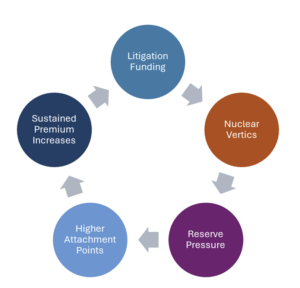
Exhibit C: Social Inflation Feedback Loop[/caption]
Casualty remains the industry’s most distressed segment. General liability posted a $14B underwriting loss in 2024 with a 121% combined ratio. Auto liability has been unprofitable for nine consecutive years (36 quarters of rate hikes, 113% combined ratio). Umbrella and excess layers face capacity constriction with attachment points doubling from $5M to $10M in high-hazard classes. The biggest driver is social inflation: tort costs growing at 8.7% annually (outpacing GDP), fueled by thirdparty litigation funding that has matured into a dedicated asset class, with “nuclear” verdicts (exceeding $10M) not uncommon. Fitch Ratings identifies reserve inadequacy in long-tail lines as the sector’s biggest structural risk—reserves set during pandemic years may prove insufficient for 2026 settlement values.
Implication for CFO & Risk Manager
Casualty premium increases are not cyclical—they reflect a self-reinforcing structural dynamic. Budget for sustained 8–20%+ annual increases in auto and umbrella. Stress-test the adequacy of the umbrella tower against “nuclear” verdict scenarios, and audit “Who Is an Insured” definitions across all subsidiaries and joint ventures.
Exhibit D: Underwriting Pressure vs. Investment Income Support


Executive Takeaway
ROE stability at ~10% masks deteriorating underwriting fundamentals but partially offset by improving investment yields (4.2%yield), which provides stabilisation. If interest rates decline or reserve adequacy deteriorates, the earnings cushion will deteriorate. CFOs should not confuse investment-supported profitability with underwriting health.
AI & Structural Transformation: The Algorithmic Pivot
The industry’s shift from “Repair & Replace” indemnification to “Predict & Prevent” risk management is accelerating. Fee-based risk prevention service revenue is projected to grow from $21.6B (2023) to $49.5B by 2030. These services focus on helping companies prevent and recover from losses and can include a variety of loss control services and devices, such as onsite risk inspections, safety education tools, and risk management technology (think telematics for safe driving, water leak sensors, and AI-driven property monitoring). This is a space that is evolving and one where carriers and brokers may be competing against each other. An example where AI is benefiting buyers and insurers is in cyber coverage, where multimodal AI fraud detection could save $80–160B in avoided losses by 2032.
On a related note, insurers and reinsurers are beginning to offer AI-specific insurance policies to address liability concerns related to AI. The AI insurance market is projected to reach $4.8B by 2032 (80% CAGR), covering algorithmic liability, copyright infringement, and “AI Washing” D&O claims.
For insureds, AI creates both opportunity and exposure, although only 11% of firms have successfully moved AI agents from pilots to production – process redesign, not technology deployment, remains the bottleneck.
Organizations deploying AI should evaluate Tech E&O and algorithmic liability coverage and keep abreast of regulatory changes. As an example, the Colorado AI Act and EU AI Act impose governance mandates that create compliance liability.
Exhibit E: Market Pricing - Strategic Risk Positioning Matrix

Executive Takeaway
Naturally, an organisation’s placement result is contingent on many factors, including losses. However, from a market pricing perspective, Casualty and AI Liability occupy the high-risk/hard-pricing quadrant—these demand attention, leveraging a strategic approach. Property’s softening pricing is a window, not a trend. Cyber’s softening market is masking emerging systemic risk (cloud catastrophe, deepfake fraud). Risk management resources should focus first on the upper-right quadrant.
3. Strategic Deep Dive
Why Casualty Risk May Offset Property Savings in 2026
Executive leadership may view the 2026 renewal cycle as a cost-reduction opportunity. Property premiums are declining, cyber is softening, and D&O capacity is abundant. The instinct to bank savings is understandable—but potentially precarious.
The Social Inflation Mechanism, Explained for the Boardroom. Social inflation is not general economic inflation applied to lawsuits. It is a distinct, self-reinforcing economic system. Third-party litigation funders—hedge funds, family offices, and dedicated investment vehicles—provide capital to plaintiffs in exchange for a share of the verdict or settlement. This capital allows plaintiffs to reject reasonable, early settlements, invest in sophisticated jury consultants and expert witnesses, and pursue multiyear litigation strategies designed to maximise the financial return on the funder’s invested capital. The courtroom has become an investment vehicle where the objective function is ROI, rather than justice and equity.
The Reserve Adequacy Time Bomb. Casualty claims can take up to 5–10 years to settle. Reserves established during the pandemic years (2020–2021) were set using loss assumptions that did not account for the post-pandemic explosion of nuclear verdicts. If those reserves prove inadequate, which credit rating agency Fitch Ratings identifies as the sector’s biggest structural risk, carriers will strengthen reserves by taking charges against current earnings. This creates a compounding effect: current premiums rise to cover current losses AND past deficiencies simultaneously.
The EBITDA and Retained Earnings Impact. For midmarket companies with significant fleet operations, contractual liability, or professional services exposure, the total cost of risk (TCoR) is shifting decisively upward on the casualty side. A company saving 15% on property ($150K on a $1M programme) while absorbing a 20% increase on auto liability, 15% on umbrella, and 10% on GL could easily see a net TCoR increase of $200K–$400K. When umbrella attachment points double from $5M to $10M, the retained risk between the primary layer and the umbrella attachment becomes a direct EBITDA exposure—one large verdict in that gap directly impacts the balance sheet.
The Long-Term Premium Trajectory. Tort costs are growing at 8.7% annually, outpacing GDP growth. Until litigation funding is regulated or tort reform is enacted, this trajectory is structural, not cyclical. Organizations should budget for sustained double-digit casualty increases for a minimum of 3–5 years and model the retained earnings impact accordingly. The question is not whether casualty costs will rise, but whether your risk financing structure can absorb the compounding pressure without impairing capital allocation for core operations.
4. Executive Action Checklist for Q1 2026
The following summarises key action items to strategically address current market dynamics:

About the Authors
Stephanie Scarola and Paula Kaeser are insurance specialists with ERA Group. They come from opposite sides of the industry and have over 35 years of collective experience in insurance. They assist clients in evaluating their insurance and benefit programs. ERA utilises its in-depth subject-matter expertise to evaluate arrangements, negotiate, and deliver best-in-class sourcing solutions for its clients.











.jpg)
.jpg)
.jpg)
.jpg)
.jpg)