
From 1 July 2026, the EU's long-standing €150duty-free de minimis threshold is being abolished. Every parcel entering the EU from a non-EU country — including the UK — will be subject to customs duty regardless of value, alongside new per-parcel handling fees and mandatory item-level declaration requirements.
The UK's own £135 threshold remains in place for now but is confirmed for removal by March 2029.
Key Changes, Dates and Who is Affected:
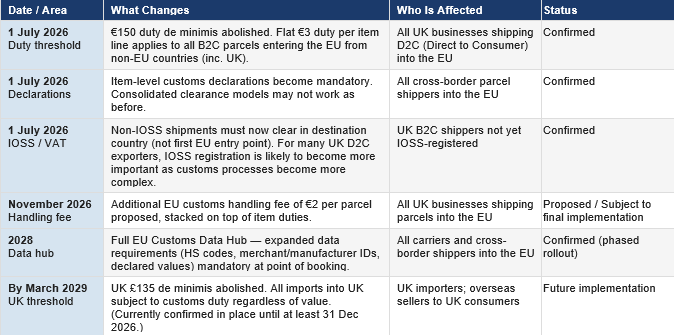
Example:
A UK retailer shipping a €25item to a consumer in Germany currently benefits from simplified low-value import treatment. Under the new regime the shipment may require item-level customs data, incur customs processing charges and potentially attract additional duty and handling costs.
Operational Implications & Actions:
Immediate priorities (before 1July 2026)
• Service review: Confirm how your current EU parcel carriers services will operate under the new item-level declaration rules — and any additional cost implications that need to be considered.
• IOSS registration: If not already registered, assess the opportunity once more. Non-IOSS shipments face destination-country clearance from July, adding cost and delay.
• Systems/data readiness: HS codes, declared values, country of origin and merchant IDs must be embedded at point of booking — not added retrospectively.
• Incoterms: Clarify with customers who will be responsible for paying for freight charges, and any customs duties, taxes and fees. Ensure this is reflected in all documents at time of shipping.
Medium-term considerations
• Cost modelling: Quantify the duty + handling fee impact across your EU shipment profile and review incoterm strategy as well as pricing and margin implications.
• Fulfilment strategy: For high-volume D2C shippers, EU-based stocking or bonded warehouse options may become commercially viable alternatives to direct UK shipment.
How ERA Group Can Help:
ERA Group's freight and logistics specialists can support your business with the following:
• Review of current carrier and fulfilment strategies.
• Assess customs readiness and compliance risks
• Evaluation of IOSS and DDP operating models
• Identifying opportunities to offset additional customs costs through logistics optimisation.